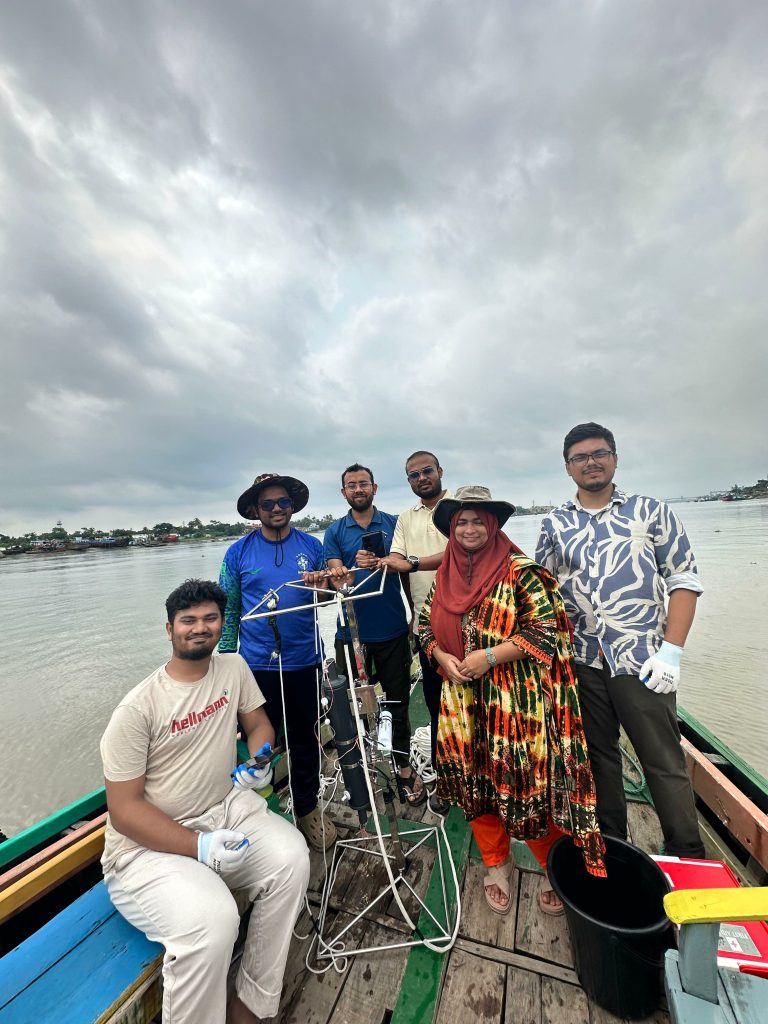
Every morning, before most of the city wakes up, a small team gathers near the river in Khulna to begin a long, wet, and muddy day of work. As a field enumerator for the GEM-in-a-Box project, my job is to collect water quality samples where the Sundarbans mangrove forest meets the sea.
The day starts at 6:30 AM, checking equipment against a list made the night before. From there, it’s an auto-rickshaw ride to Rupsha 7 No Ghat, hiring a local boat, and a quick breakfast before pushing off.
Before moving, we mark sampling stations on Google Earth Engine, since the tides here can change fast. At each station, we take three water samples for accuracy, using a Niskin bottle, CTD, and mini-DOT sensor lowered to about 5 metres, plus surface and sediment samples. It’s muddy work, sometimes I slip and land in mud, but it’s part of the job.
None of this is possible without local guides and the ADAMS Foundation, who handle logistics so the team can focus on the science.
By afternoon, we’re back at the hotel checking instruments, eating a late lunch, and then moving samples into the lab for nutrient analysis (DIN, SRP, Silica) using the DR1900 spectrophotometer.
This work matters because it tracks the health of one of the world’s largest mangrove ecosystems, one water sample at a time.