🌊 Innovation in GEM-in-a-Box Field Monitoring
Turning a recurring field challenge into a practical engineering solution for river and estuarine monitoring.
🚧 The Challenge
Fieldwork does not always go as planned. During the GEM-in-a-Box monitoring work in the Khulna–Sundarbans river–mangrove area, our team repeatedly encountered the same obstacle. To collect water samples, we use a Niskin bottle together with a CTD and a mini-DOT sensor. Normally, a heavy metal messenger slides down the rope to trigger the bottle closure at the desired depth. While this works well in calm water, the rivers near the Sundarbans are rarely calm. Strong tidal currents, moving boats, and changing rope angles often prevented the messenger from striking the trigger correctly. As a result, the bottle failed to close, samples were lost, and the sampling process had to be repeated—costing valuable time and effort.
💡 Our Solution
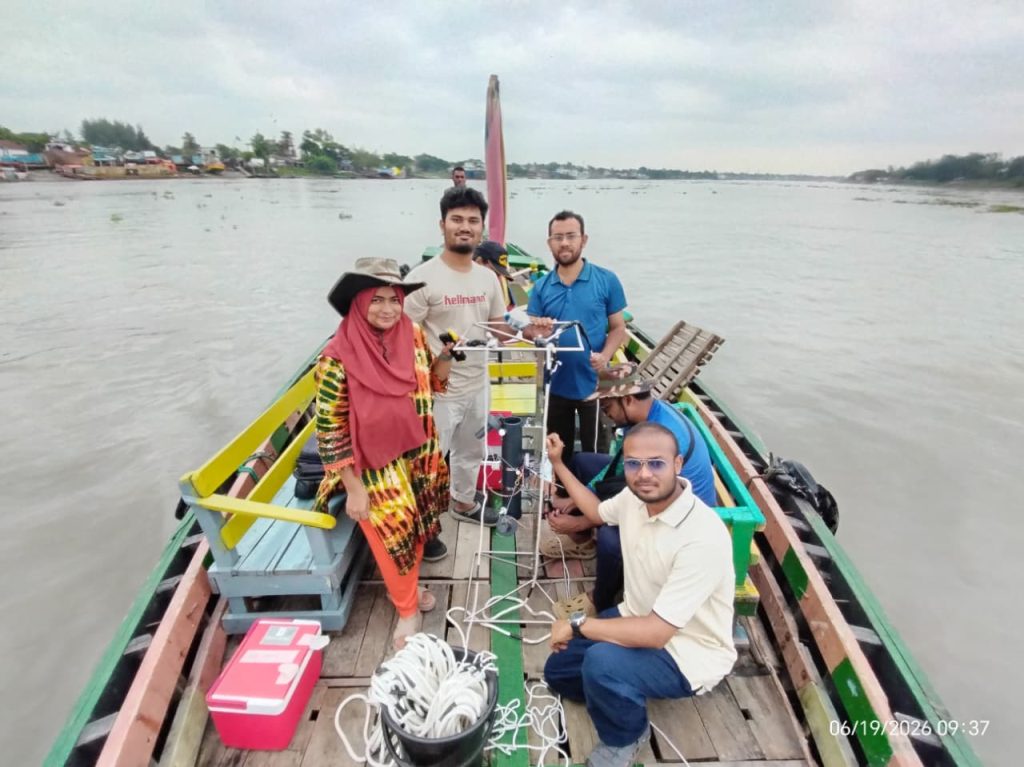
To overcome this limitation, we designed a simple but effective sampling frame that completely removes the need for the traditional messenger weight. The new frame keeps both ends of the Niskin bottle open using a locking mechanism. A control rope connected to the lock remains with the boat operator. Once the desired sampling depth is reached, the operator simply pulls the rope, instantly releasing the lock and allowing both ends of the bottle to close simultaneously, capturing water precisely from the target depth.
⚙️ Why This Design Works
🌊 Reliable in Strong Currents
The rope-operated mechanism works even when tidal currents and rope angles change.
🧪 Cleaner Water Samples
Both ends close simultaneously, reducing contamination and improving sampling accuracy.
📊 Integrated Measurements
The frame securely holds the CTD and mini-DOT beside the Niskin bottle, ensuring all instruments sample the same water body simultaneously.
✅ Field Test Success
The prototype was tested for the first time during GEM-in-a-Box fieldwork near the Sundarbans. The equipment was lowered to a depth of 5 metres. Once the target depth was reached, the operator pulled the control rope. The locking system released smoothly, the bottle closed perfectly, and a clean water sample was collected alongside complete CTD and mini-DOT measurements. Everything worked successfully on the very first attempt.
🚀 Looking Ahead
Although the modification is small, it addresses a persistent challenge faced by field teams working in rivers and estuaries. The next phase will involve testing the frame at greater depths and under stronger tidal conditions to evaluate its reliability across a wider range of field environments.